


Amber-Dawn Bear Robe Wants Fashion to Think Bigger
Amber-Dawn Bear Robe (Siksika Nation) has spent her career challenging where Indigenous fashion is allowed to exist. This season at Fashion Art Toronto (FAT), she opened the runway with a curated presentation of Jontay Kahm, Ayimach Horizons, and Mobilize Waskawewin — not as a cultural segment, but as a statement of contemporary design.
“I really admire what Vanya has created,” she says of FAT’s founder, Vanja Vasic, referencing the platform’s creativity and energy. “It’s one of the best Canadian runways.”
Bear Robe’s method is unusual in fashion. She refuses to editorialize the designers she champions.
“I don’t dictate what they do,” she explains. “They come to the runway knowing what their style and their vision are. The point is visibility — not re-interpretation through Western frameworks.”
Instead, she architects context — creating space for Indigenous creators to operate as part of fashion’s critical center.
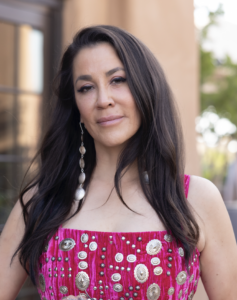
Amber Dawn Bear Robe in custom chizhii.
The Designers
Jontay Kahm made his Canadian runway debut — a point Bear Robe wants recorded in fashion history. A former student of hers, Kahm inverts Cree powwow aesthetics into sculptural forms that read like modern armour. The work is intricate, mathematical, deeply rooted. Kahm’s showcase marked something historic. Sarain Fox and Chyana Maroe Sage walked for the brand. “It was very monumental that this was Jontay’s first runway show in Canada,” she stresses. “That needs to be documented in history.”
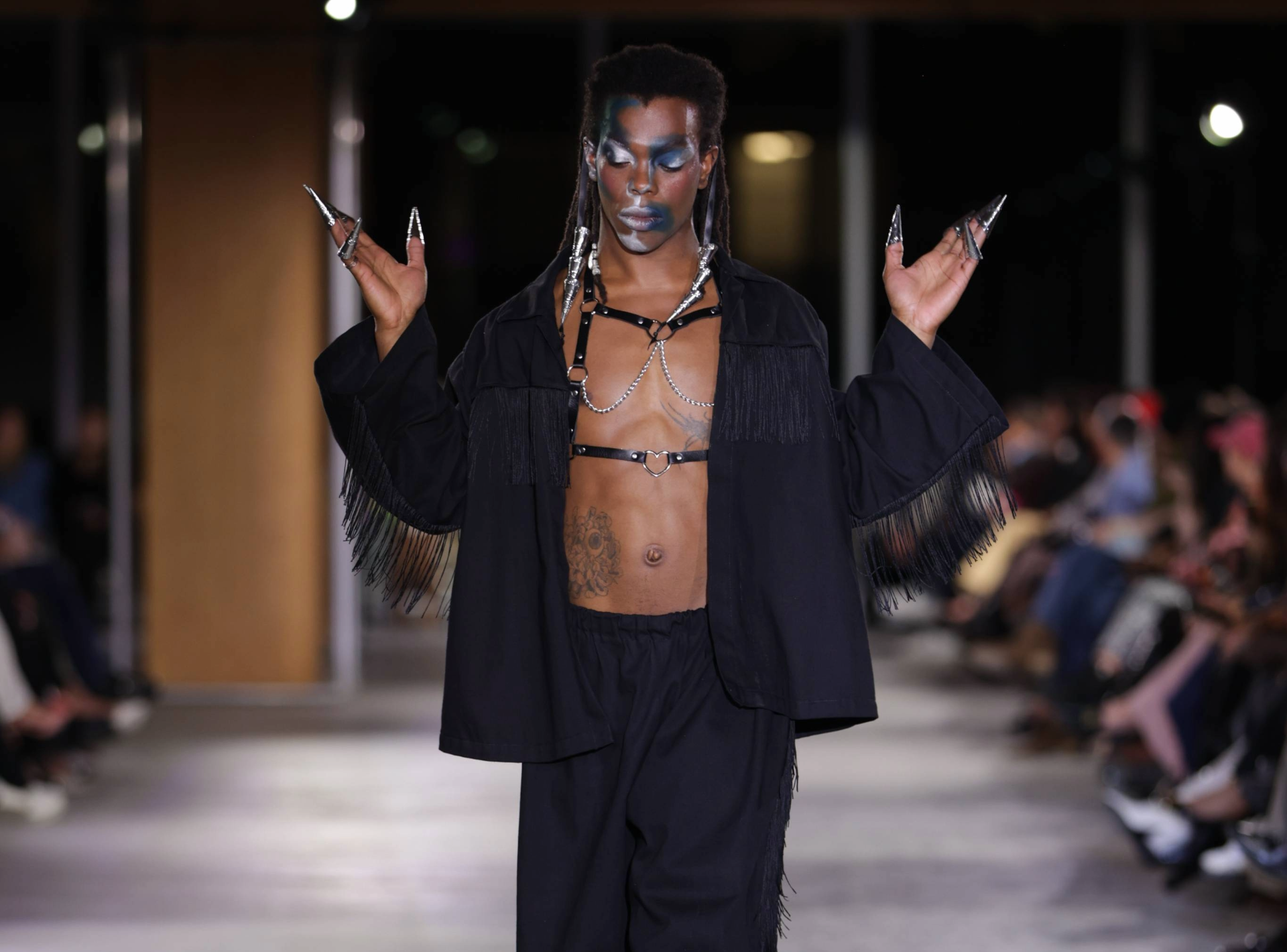
Ayimach Horizons, the label from multidisciplinary artist Jason Baerg, blurs painting, digital mapping, and garment design. His silks move like brushstrokes; each look feels engineered for motion rather than display. The showcase featured Indigenous models who are leaders in their communities, including Andrea Alfred, Susan Blight and Justine Woods.
Mobilize Waskawewin, by Dusty LeGrande, pushes Indigenous design into streetwear — gender-fluid, graphic, and worn like a declaration. The brand’s name translates roughly to “mobilize the truth,” and the clothes do exactly that. The brand also featured indigenous models who are leaders in their communities including Riley Kucheran, Kisik Whiskeyjack, Hinauri Nehua-Jackson, Armando Perla and Jason Baerg.
Three different expressions. One unified shift. While Indigenous-led platforms have been crucial, Bear Robe is clear — the next step is not another silo. Bear Robe talks about integration more than inclusion.
“We’ve had Indigenous-only platforms — and they were necessary — but now it’s time to collaborate with the industry as a whole,” she says. She wants major fashion houses to commit beyond seasonal partnerships. “Hire Indigenous designers as part of your creative teams. Make it long-term, not decorative.”
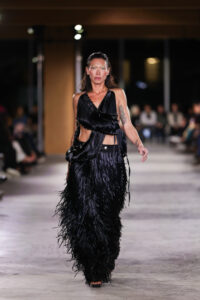
Sarain Fox for Jontay Kahm
Out of the Bubble
Next, Bear Robe moves to Parsons School of Design, where she’ll teach History of Contemporary Indigenous Fashion in the School of Art and Design History and Theory.
“New York has the world’s ear,” she says. “When change happens there, the industry pays attention.” She’ll join indigenous colleagues Justine Woods and Patricia Michaels, both bringing distinct voices from Canada and the U.S. into the classroom.
Building Futures
For Bear Robe, the goal isn’t representation — it’s infrastructure. Designers with the resources to grow.
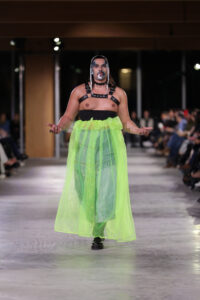
Riley Kucheran for Mobilize
Models who can build sustainable careers. Exhibitions and runways that don’t position Indigenous artistry as novelty, but as a core narrative in global fashion.
She’s candid about the tensions within the field — the growing pains of visibility.
“There’s competition creeping in. But my hope is that we keep building community, stability, and profit — so these designers become household names.”
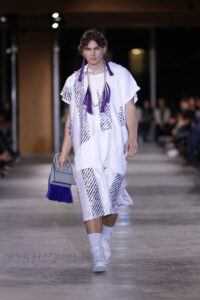
Gabriel Hodgins for Ayimach Horizons
Want more? Read this – L’uomo Strano Walks for the Dolls and Demands You Pay Attention


